Choosing a Backend in 2026: Convex, InsForge, or Supabase?
You need a backend. Supabase is the obvious choice. Everyone uses it, and for good reason.
I just built an AI-powered events app with Supabase. I enjoyed using it. But I kept hearing developers rave about Convex and InsForge. It was the kind of love you don’t usually see for backend tools.
So I got curious. What’s the hype about? When would you actually choose one of these over Supabase?
This post breaks down all three so you can pick the right one for your project.
TL;DR
- Supabase is the safe, mature choice: PostgreSQL foundation, largest community, battle-tested at scale
- Convex is best when real-time is your core feature, not an add-on. Queries auto-update without setup
- InsForge is for AI-assisted development where your agent controls infrastructure via MCP, instead of just generating code
- All three are open source and self-hostable
- My recommendation: Start with your most important constraint (SQL? Real-time? AI workflow?) and let that guide your choice
Who This Article Is For
Before we dive in, let me be clear about who this is for:
- Indie devs and solo founders choosing a stack for their next side project
- Startup CTOs evaluating backends for a new product
- AI-assisted coders (Cursor, Claude Code users) wondering if InsForge is worth trying
- Supabase users curious if the grass is greener
If you’re on an enterprise team with dedicated DevOps, or you need on-prem compliance (HIPAA, government), this comparison probably isn’t for you.
The Three Contenders
Here’s the quick overview before we go deep:
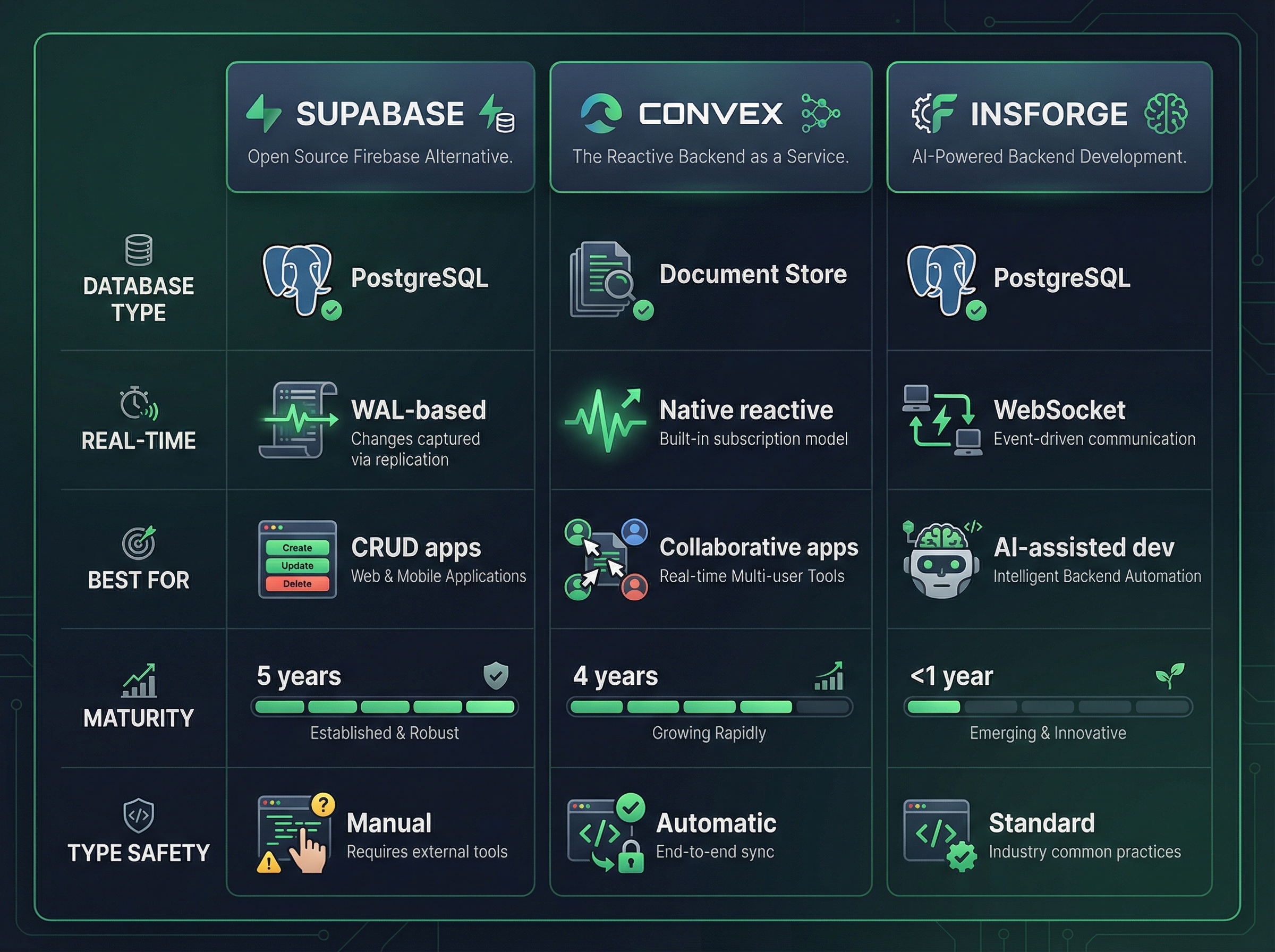
| Supabase | Convex | InsForge | |
|---|---|---|---|
| One-liner | Postgres for everything | Real-time by default | Backend your AI agent can control |
| Database | PostgreSQL (relational) | Document store (reactive) | PostgreSQL |
| Founded | 2020 | 2021 | 2025 |
| Open source | Yes | Yes | Yes |
| Best for | CRUD apps, SQL fans | Collaborative/real-time apps | AI-driven development with Cursor/Claude Code |
Now let’s break down each one.
Supabase: The Mature Choice
Supabase has become the default backend for a reason. It gives you PostgreSQL with a nice UI, auth, storage, and real-time capabilities—all in one dashboard.
What It Does Well
PostgreSQL foundation. You get SQL, ACID transactions, joins, and the entire Postgres extension ecosystem. If you know SQL, you’re productive immediately.
Generous free tier. 50K monthly active users, unlimited API requests, and 500MB of database storage. You can build and launch a real product without paying anything.
Batteries included. Auth, storage, real-time, and edge functions all live in one place. You don’t need to stitch together five different services.
Largest community. When you hit a problem, someone on Stack Overflow or Reddit has probably solved it. The docs are excellent, and there are tutorials for almost every framework.
Self-hostable. No vendor lock-in. If you outgrow the hosted version or need more control, you can run it yourself.
Where It Falls Short
Shared responsibility model. With Supabase, you’re responsible for securing data access with Row Level Security policies, handling query performance with proper indexes, and managing schema migrations. It’s powerful, but it’s also more surface area for bugs.
Real-time requires setup. Supabase’s real-time feature watches the PostgreSQL WAL (write-ahead log), not your queries directly. This means you need to enable it per table and think carefully about how you structure your subscriptions.
RLS complexity. Row Level Security is powerful, but policies can get complex as your app grows. I hit a recursion issue in my project where RLS policies were checking a table that itself had RLS policies, creating an infinite loop. The fix was straightforward (a SECURITY DEFINER function), but it’s the kind of thing you don’t see coming until you hit it.
Pro tip: RLS can also tank performance if you’re not careful. Adding an index on columns used in your policies (like
user_id) can improve query speed by 100x on large tables. Wrapping functions inselect(e.g.,(select auth.uid()) = user_idinstead ofauth.uid() = user_id) lets the optimizer cache results instead of calling the function per row.
Offline support is DIY. If your app needs to work offline and sync later, you’ll need to build that yourself or bring in another library.
Assembly required. Supabase gives you all the pieces, but it can feel like you’re integrating separate tools rather than using one unified platform. Auth, database, storage, and real-time all work together, but they don’t feel like one product the way some alternatives do.
My Experience Building BA Events
I used Supabase to build BA Events, an AI-powered app that helps people find events in Buenos Aires. Here’s what I found:
Auth worked well once I understood the PKCE flow for magic links. The documentation walked me through it, and I had email/password plus magic link auth working in an afternoon.
RLS needed some debugging. I hit the recursion issue I mentioned: my admin check was causing an infinite loop. Once I understood the problem, the fix was a simple SECURITY DEFINER function. Not a big deal, but something to be aware of.
Overall, it was smooth. I went from zero to deployed MVP quickly. The SQL foundation made complex queries easy, and I never felt limited by the platform.
Convex: The Real-Time Native
Convex takes a different approach. Instead of bolting real-time onto a traditional database, they built the entire system around reactivity from day one.
What It Does Well
Real-time by default. You don’t enable real-time or set up websockets. Every query is a subscription that automatically updates when data changes. This isn’t a feature—it’s how the whole system works.
// This automatically updates when data changes
const events = useQuery(api.events.list)
That’s it. No channels, no subscriptions to manage, no cleanup. When the data changes, your UI updates.
TypeScript end-to-end. Convex generates types from your schema automatically. Your frontend knows exactly what shape your data has, and your IDE catches errors before you run anything.
// Schema defines your types
const events = defineTable({
  name: v.string(),
  date: v.string(),
  venueId: v.id("venues"),
})

// Frontend automatically knows the shape
const events = useQuery(api.events.list)
// events is typed as Array<{ name: string, date: string, venueId: Id<"venues"> }>
Fast under load. Convex reports sub-50ms latency at 5,000 concurrent connections. For real-time apps where responsiveness matters, this is significant.
Backend logic as functions. Your server code is just TypeScript functions. No REST endpoints to define, no API routes to manage.
export const create = mutation({
  args: { name: v.string(), date: v.string() },
  handler: async (ctx, args) => {
    return await ctx.db.insert("events", args)
  },
})
Open source and self-hostable. If you need to self-host for compliance or cost reasons, you can. Convex open-sourced their backend, dashboard, and CLI in early 2025.
Full responsibility model. Convex handles authorization, caching, and consistency for you. When you write a query or mutation, Convex guarantees it runs correctly without you managing RLS policies or cache invalidation. Fewer footguns.
Actions for external APIs. When you need to call third-party services (Stripe, OpenAI, SendGrid), Convex has a dedicated primitive called Actions. These run in a separate execution context from your database queries, keeping your core data operations fast and deterministic.
// Actions for external API calls
export const sendEmail = action({
  args: { to: v.string(), subject: v.string() },
  handler: async (ctx, args) => {
    await sendgrid.send({ to: args.to, subject: args.subject })
    // Can also call mutations to update database
    await ctx.runMutation(api.emails.markSent, { to: args.to })
  },
})
TypeScript-first schema. Instead of writing SQL migrations, you define your schema in TypeScript and Convex generates everything. No more “did I run that migration?” questions. Your schema is code, versioned with your app.
Built-in AI/RAG support. Convex has native vector search and RAG components. You can store embeddings, run semantic searches, and build AI features without integrating a separate vector database. According to Convex, 80% of apps built on their platform are AI applications, and the tooling reflects that focus.
Where It Falls Short
Document store, not relational. There’s no SQL. If you’re coming from Postgres and think in joins and foreign keys, Convex requires a mental shift. You model relationships differently.
Bandwidth limits. The free tier has a 1GB bandwidth threshold that some developers have hit faster than expected. Worth monitoring if you’re building something read-heavy.
Pagination and caching need work. Some developers report that caching doesn’t behave as expected, and paginated queries don’t always hit the cache efficiently.
No heavy analytics. If you need to run large aggregations or map-reduce style queries, you’ll need to stream data to a separate analytics database.
Smaller ecosystem. Fewer tutorials, fewer Stack Overflow answers, fewer people who’ve hit your specific problem. The community is growing, but it’s not Supabase-sized yet.
When Convex Shines
Convex is built for apps where real-time isn’t a feature—it’s the product:
- Collaborative tools (Figma-style, multiplayer editing)
- Chat applications
- Live dashboards
- Multiplayer games
- Anything where users expect instant updates
If you’re building a traditional CRUD app where real-time is nice-to-have, Convex might be overkill. But if your app’s core value depends on live updates, Convex removes a lot of complexity.
InsForge: The Agent-Native Backend
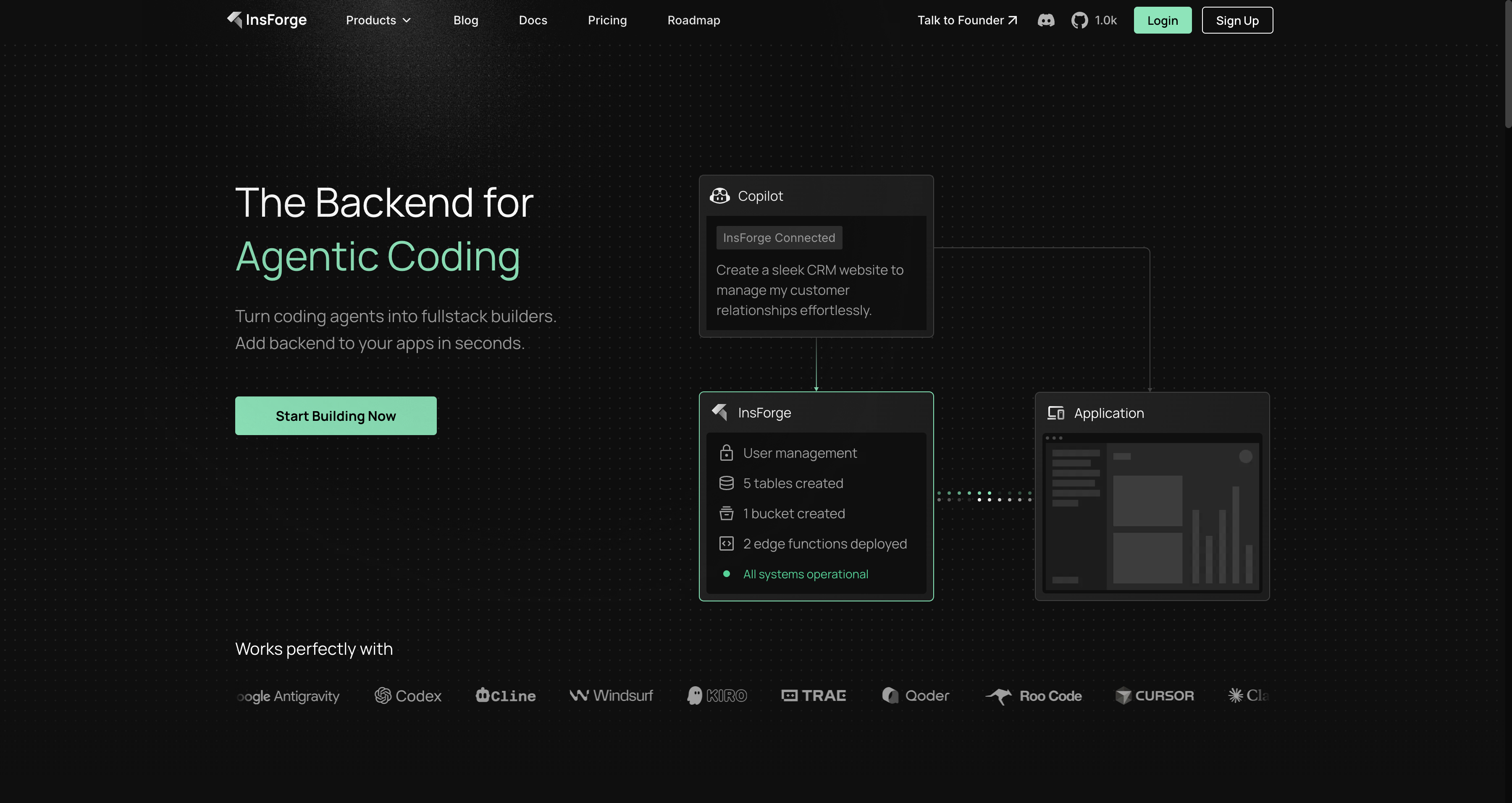
InsForge is the newest player, launched in November 2025. But “AI-native” doesn’t mean what you might think. It’s not about AI features in your app. It’s about letting AI agents control your backend infrastructure.
The Problem InsForge Solves
Here’s the insight behind InsForge: coding is now the easy part. With Cursor, Claude Code, or similar tools, you can build a working prototype in hours. But making it production-ready still requires manual work:
- Switching tabs to open Supabase/Firebase dashboards
- Copying API keys and pasting them into
.envfiles - Clicking through GUIs to configure OAuth providers
- Setting up database tables through web interfaces
- Writing RLS policies that AI agents struggle to debug
AI agents can literally walk you through every step (“go to this URL, click that button, paste this key”), but they can’t actually do it themselves. Existing platforms were built for humans clicking dashboards, not for agents making API calls.
What It Does Well
MCP-first architecture. InsForge exposes its entire backend through the Model Context Protocol (MCP). Your AI agent connects directly and can create tables, configure auth, manage storage, and deploy functions, all programmatically without you touching a dashboard.
# Connect Claude Code to InsForge via MCP
npx @insforge/install --client claude-code \
  --env API_KEY=ik_your_api_key \
  --env API_BASE_URL=https://your-app.insforge.app
The agent becomes the developer. Tell Claude Code “build me an Instagram clone” and it can autonomously:
- Create users, posts, comments, and likes tables
- Configure Google OAuth and email/password auth
- Set up image storage buckets
- Generate the complete frontend
No manual dashboard navigation. No copy-pasting API keys. The agent handles infrastructure end-to-end.
Consistent, predictable APIs. Every endpoint follows the same patterns with deterministic responses. This reduces AI hallucination. Agents learn the system once and generate correct code without extensive context.
RLS handled differently. Supabase’s Row Level Security is enabled by default, which causes queries to fail without policies. AI agents often struggle to debug RLS errors. InsForge takes a different approach to security that’s more agent-friendly.
Where It Falls Short
Very new. Founded in July 2025 by ex-Amazon, Databricks, Meta, and TikTok engineers, with $1.5M in funding raised in 2025. The team is strong, but less battle-testing means more uncertainty.
Limited to specific AI tools. MCP integration works best with Claude Code, Cursor, and Windsurf. If you’re not using these tools, you lose the main benefit.
Smaller feature set. InsForge deliberately launched with just Auth, Database, and Storage (far fewer features than Supabase). They’re focused on nailing the AI-agent use case first.
Early documentation. When you hit edge cases, you might be exploring uncharted territory. The community is small but growing.
When InsForge Shines
InsForge makes sense when:
- You’re building primarily with AI coding assistants (Cursor, Claude Code, Windsurf)
- You hate context-switching between your editor and backend dashboards
- Speed to MVP matters more than production scale (you can always migrate later)
- You’re prototyping and want to minimize manual infrastructure work
- You’re curious about where AI-assisted development is heading
If you’re not using AI coding tools, InsForge’s main advantage disappears. You’d be better off with Supabase’s mature dashboard. But if you live in Cursor or Claude Code, InsForge removes friction that other backends can’t.
Code Comparison: See the Difference
Let’s look at the same tasks across all three platforms.
Real-Time Data Subscription
Supabase:
// Setup: enable realtime on table first
const channel = supabase
  .channel('events')
  .on('postgres_changes',
    { event: '*', schema: 'public', table: 'events' },
    (payload) => {
      console.log('Change received:', payload)
      // Manually update your state
    }
  )
  .subscribe()

// Don't forget to unsubscribe
return () => supabase.removeChannel(channel)
Convex:
// Just works
const events = useQuery(api.events.list)
// Automatically re-renders when data changes
// No cleanup needed
InsForge:
// Similar to Supabase. InsForge uses PostgreSQL under the hood
const { data } = useInsForge('events', { realtime: true })
// The difference: your AI agent set this up without you touching a dashboard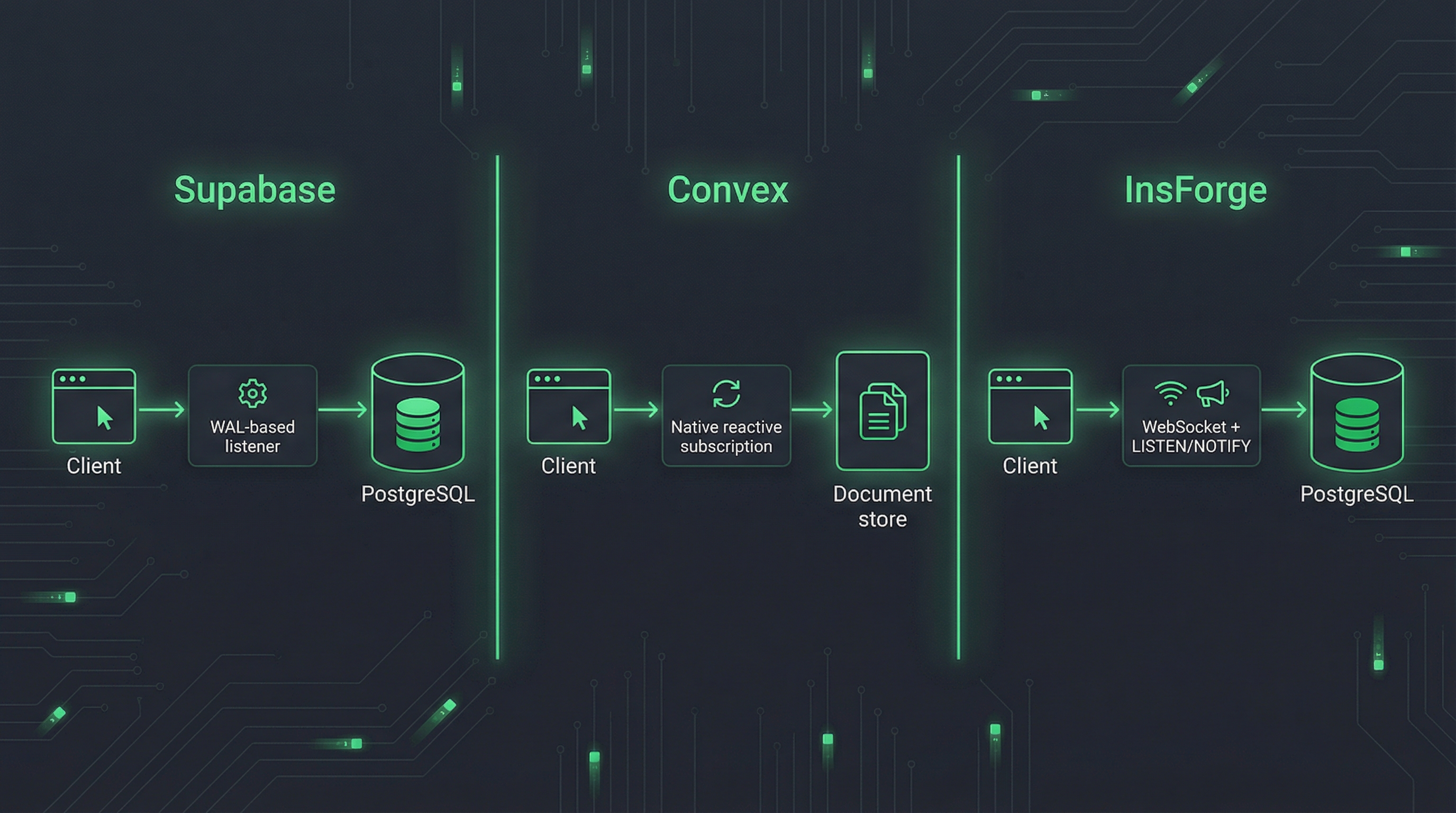
Creating a Record
Supabase:
const { data, error } = await supabase
  .from('events')
  .insert({ name: 'Concert', date: '2025-01-15' })
  .select()

if (error) {
  console.error('Error:', error)
}
Convex:
const createEvent = useMutation(api.events.create)

// Type-safe, auto-validated against schema
await createEvent({ name: 'Concert', date: '2025-01-15' })
InsForge:
// The code looks similar to Supabase
await insforge.events.create({ name: 'Concert', date: '2025-01-15' })

// But the setup was different: you told Claude Code "add an events table"
// and it created the table, types, and API via MCP. No dashboard needed
Head-to-Head Comparison
Real-Time Capabilities
| Supabase | Convex | InsForge | |
|---|---|---|---|
| Setup required | Yes (enable per table) | None | Minimal |
| Mechanism | WAL-based | Native subscriptions | WebSocket + LISTEN/NOTIFY |
| Latency under load | 100-200ms p99 | Sub-50ms | Varies |
| Mental model | Events you subscribe to | Queries that auto-update | Standard real-time |
Developer Experience
| Supabase | Convex | InsForge | |
|---|---|---|---|
| Type safety | Manual or generated | Automatic end-to-end | Standard |
| Learning curve | Low if you know SQL | Medium (new mental model) | Low if using AI tools |
| Setup workflow | Dashboard + copy-paste | CLI + code | AI agent via MCP |
| Documentation | Excellent | Good | Growing |
| Community size | Large | Medium | Small |
Maturity and Risk
| Supabase | Convex | InsForge | |
|---|---|---|---|
| Age | 5 years | 4 years | <1 year |
| Funding | $116M+ | $26M | $1.5M |
| Production usage | Thousands of apps | Growing | Early adopters |
| Self-hosting | Yes | Yes | Yes |
Decision Framework: Choose X If…
Choose Supabase If:
- You need SQL and relational data modeling
- The Postgres ecosystem matters (extensions, tooling, familiarity)
- Real-time is nice-to-have, not your core feature
- You want the largest community for troubleshooting
- You might need to self-host later
- You’re building a traditional CRUD application
Choose Convex If:
- Real-time is your app’s core feature
- You’re building collaborative or multiplayer experiences
- You love TypeScript and want end-to-end type safety without effort
- You want the simplest mental model for reactivity
- You’re okay with a document store (no SQL)
- You want your UI to “just update” when data changes
Choose InsForge If:
- You live in Cursor, Claude Code, or Windsurf and hate switching to dashboards
- You want your AI agent to handle infrastructure, not just generate code
- Speed to MVP matters more than production scale right now
- You’re comfortable being an early adopter of MCP-based tooling
- You’re prototyping and can migrate to Supabase later if needed
- You want to see what “agent-native” development actually feels like
What I’d Pick for My Next Project
I built BA Events with Supabase. Here’s my honest take after shipping it:
What worked: Auth was solid once configured. The SQL foundation made complex queries easy. I could write joins and aggregations without thinking twice. The community saved me hours when I hit edge cases.
For my next project:
If it’s real-time heavy (chat, collaboration, live updates as a core feature), I’d use Convex. The “just works” reactivity is compelling, and I’d rather spend my time on features than configuring websockets.
If it’s a traditional CRUD app with complex data relationships, I’d stick with Supabase. SQL is battle-tested, the ecosystem is huge, and the platform does what I need.
If I’m speed-running a prototype with Claude Code and want my agent to handle everything (including infrastructure setup), I’d try InsForge. The MCP integration means I never leave my editor. It’s early, but the “agent does everything” workflow is compelling enough to experiment with.
There’s no universal “best.” The right choice depends on what you’re building and how you work.
FAQ
Can I migrate from one platform to another later?
Yes, but with caveats. Supabase and InsForge both use PostgreSQL, so migrating between them is relatively straightforward: export your schema and data, adjust your client code. Convex uses a document store, so moving to/from Convex requires restructuring your data model and rewriting queries. Plan for this if you’re prototyping.
Which has the best free tier?
Supabase’s free tier is the most generous for typical use cases: 50K monthly active users, unlimited API requests, 500MB database. Convex’s free tier is solid but has a 1GB bandwidth limit that some developers hit faster than expected. InsForge’s free tier is competitive but the platform is newer, so limits may change.
Do I need to know SQL for any of these?
Only Supabase requires SQL knowledge. Convex uses TypeScript functions for all data operations (no SQL at all). InsForge uses PostgreSQL under the hood, but your AI agent handles most of the SQL generation if you’re using it as intended.
What about vendor lock-in?
All three are open source and self-hostable, which reduces lock-in risk. Supabase has the most mature self-hosting story. Convex open-sourced in early 2025. InsForge is also open source. Your biggest lock-in risk is the API/SDK patterns, not the infrastructure.
Conclusion
The fact that we’re comparing three strong backend options in 2026 is a win for developers. Five years ago, your choices were Firebase or build it yourself.
Here’s the summary:
- Supabase is the safe, mature choice. PostgreSQL foundation, largest community, proven at scale.
- Convex is the DX-focused choice for real-time apps. If live updates are central to your product, it removes significant complexity.
- InsForge is the bet on agent-native development. If you want your AI coding assistant to control infrastructure (not just generate code), this is currently the only option built for that workflow.
My suggestion: try the free tier of each before committing. Build a simple todo app or chat interface in all three. You’ll know within a few hours which one fits your brain.
Start with your most important constraint (real-time? SQL? AI workflow?) and let that guide your choice.
Want to see Supabase in action? Check out BA Events, the app I built with it. Or if you’re interested in more comparisons like this, follow me on X where I share what I’m learning as I build.
